
Will Gadsby Peet
Strategic Director
Will helps our clients identify the most effective routes to sustainable commercial growth.

See which third-party sources AI search tools cite, why LinkedIn stands out and what external evidence can do to support stronger AI visibility.
Our research into AI visibility in the energy sector found that LinkedIn was the most cited third-party source in AI search answers, appearing in 15.3% of responses. However, organisations with stronger third-party authority were no more likely to appear in AI answers. External coverage helps AI search tools validate your story, but it can’t compensate for a website that doesn’t clearly explain who you are, what you do, and why you should be recommended.
If you’re looking for a list of websites to get mentioned on so that ChatGPT recommends you – most AI search optimisation advice comes with one – I have some bad news.
It’s not that simple.
When we analysed AI visibility across 86 UK energy organisations using our AI Performance Analyser, we looked at the third-party sources AI search tools used when forming their answers.
Here’s what we found.
Please note: While our dataset focused on the energy sector, I believe the mechanics apply across all professional services and B2B sectors. But that’s me extrapolating, so treat the principles as portable and the percentages as energy-specific.
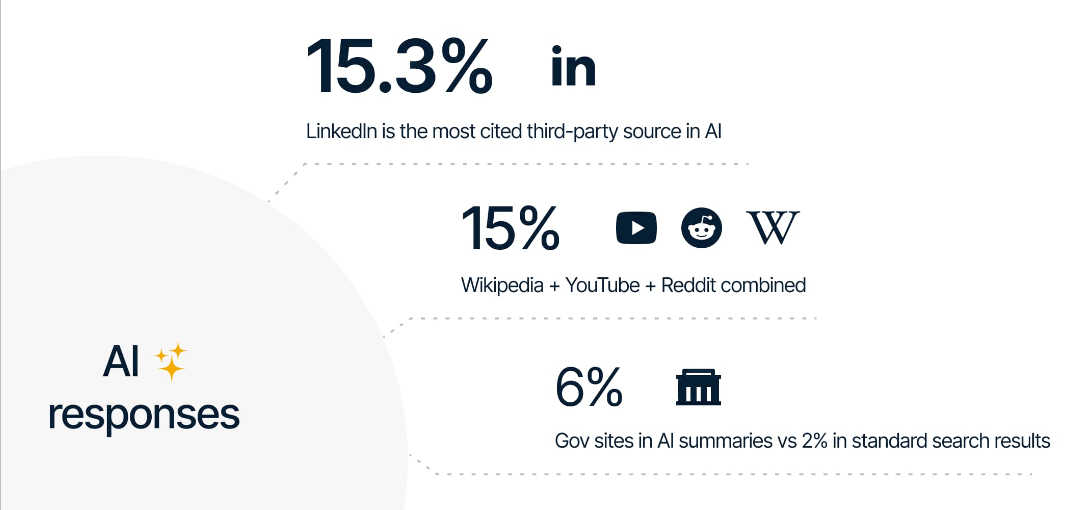
LinkedIn was the most cited third-party source in our research, appearing in 15.3% of AI responses.
For comparison:
Even the most cited source turned up in roughly one answer in six. Nothing dominated.
That makes LinkedIn interesting, particularly for organisations where people, expertise, and professional reputation matter. However, it doesn’t make LinkedIn a magic button for AI search visibility (I write this aware of the irony that I will primarily promote this piece on LinkedIn). We explore more on why LinkedIn is becoming critical for AI search visibility here.
The Government site figure is also one to pay attention to as it’s three times more prevalent in AI search than traditional search.
For energy firms, that means Ofgem, DESNZ, and NESO registers. For other sectors, it is the standard regulatory record: the SRA or Law Society for legal, ICAEW for accountants, the FCA Financial Services Register, ARB for architects, and RICS for surveyors. Above all, every UK business has Companies House.
These are the official registries buyers check before signing a contract – and the ones AI search tools query in milliseconds. If your website claims you are a 200-person firm founded in 2009, but Companies House or your regulatory filings state otherwise, you introduce conflicting signals.
That discrepancy is precisely what can cause AI platforms to lose confidence and hedge their recommendations or skip over your organisation entirely.
Read more: How we measure what AI is saying about your organisation
This is the important bit.
Our authority score measured third-party credibility using signals such as expert authorship, citations, and trusted references. Across the 86 organisations, the average authority score was 39 out of 100.
We found no relationship between authority and visibility.
In plain English, having a bigger external footprint did not, by itself, make an organisation more likely to appear in AI answers. AI search may cite LinkedIn, a publication, or other websites to get information about your organisation while answering a question. That doesn’t mean that source was the reason it chose to recommend the organisation in the first place.
GridBeyond, which led our index with an overall score of 73/100, shows how this dynamic works in practice. On its site, GridBeyond claims an award-winning platform – a statement AI search treats with scepticism on its own. But independent third-party sources corroborate the claim: Frost & Sullivan published their release for the 2019 Technology Innovation Award, and Risk.net covered their win as Energy Risk’s 2024 Technology Firm of the Year.
When your website and third parties tell the same story, AI search can repeat it with confidence.
Read more: What Google’s latest AI search guidance really means for marketers
Reddit, for example, might be extremely useful when thousands of people are actively discussing and reviewing a consumer product. That doesn’t mean every accountancy firm, consultancy, or law firm suddenly needs a Reddit strategy.
The question you should be asking yourself is this: where does credible evidence about your organisation naturally exist?
That might include:
The exact mix will differ. The principle underlying it doesn’t.
Read more: Will AI search stop people visiting my website?
Is it possible to control what AI search says about your organisation? Our research found that third-party sources work best when they verify a clear story rather than having to create one.
If your website clearly explains what you do, who you help, and why someone should choose you, external sources can reinforce that picture. If your website is vague and those external sources tell different stories, AI search is left to fill in the gaps.
That is the real lesson for B2B marketers.
Don’t chase citations for the sake of citations. Build a clear story on your own website, then make sure the same story is reinforced across the places your customers, peers, and industry actually trust.
Read more: A framework for building service pages AI actually wants to recommend
Interested to see how the top UK energy organisations perform in AI search?
Download The state of AI visibility in the energy sector 2026 report.
Strategic Director
Will helps our clients identify the most effective routes to sustainable commercial growth.
View my other articles and opinion pieces below
We analysed 86 UK energy companies to see how ready they are for AI search. The average AI Readiness score was just 36 out of 100, and only one company cleared our benchmark of 70. The biggest issue wasn’t technical performance. Most websites could be accessed by AI platforms, but far fewer gave them enough clarity, evidence, and confidence to recommend the business.

A good service page needs to do more than rank in Google. It needs to give AI search tools enough information to understand what you offer, who it is for, and why you should be recommended over someone else. Our research into 86 UK energy organisations points to four things to get right when it comes to AI search optimisation.
On the Monday evening of London Climate Action Week, with London cooking under a record-breaking heatwave, the most sensible place in the city was underground. We brought a room full of marketers together from across climate tech, clean energy, and sustainability, in an 18th century port cellar, for an eco wine tasting. The wine was […]