
Will Gadsby Peet
Strategic Director
Will helps our clients identify the most effective routes to sustainable commercial growth.

See what our analysis of 86 UK energy organisations reveals about AI visibility, readiness and why technically sound websites still miss recommendations.
We analysed 86 UK energy companies to see how ready they are for AI search. The average AI Readiness score was just 36 out of 100, and only one company cleared our benchmark of 70. The biggest issue wasn’t technical performance. Most websites could be accessed by AI platforms, but far fewer gave them enough clarity, evidence, and confidence to recommend the business.
We wanted to know how ready the sector actually is.
exceptional™ analysed 86 UK energy organisations using our AI Performance Analyser. It scores how well a company can be found, understood, and recommended by AI search tools.
The average score was 36 out of 100.
Only one company, GridBeyond, scored above our benchmark of 70 for AI readiness.
That sounds pretty bleak – but the interesting bit is why the scores were so low.
Our analysis looks at four things:
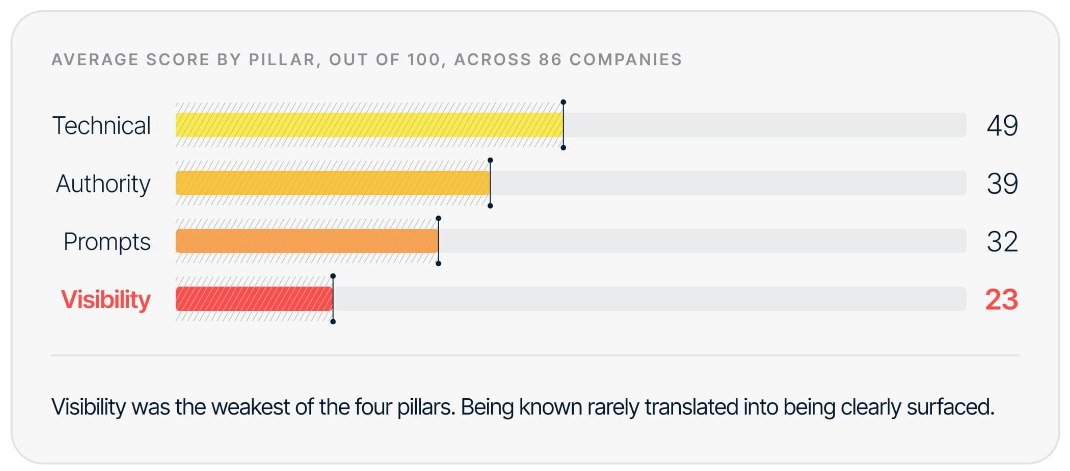
As you can see, technical accessibility was comfortably the strongest area, averaging 49 out of 100. Visibility was the weakest at 23.
Most energy websites are reasonably well built for AI platforms to access. They just aren’t giving those platforms enough useful information to confidently recommend the company.
We found no meaningful relationship between technical accessibility and visibility. For example, Flexitricity scored 28 on Technical but 80 on Visibility.
That’s because, despite its relatively low Technical score, Flexitricity’s service pages are packed with the kind of signals AI platforms are looking for.

Its Demand Side Response page, for example, explicitly states who the service is for (businesses with behind-the-meter energy assets), identifies specific assets (like refrigeration, HVAC systems, and heat pumps) and explains the outcome of the service. That’s exactly the kind of useful content AI platforms need to surface an organisation.
That gap between technical accessibility and visibility helps explain why good SEO doesn’t guarantee visibility in AI search.
A fast, crawlable website is the foundation. It doesn’t make you the obvious recommendation.
Read more: How we measure what AI is saying about your organisation
AI platforms can often tell that a company exists and give you a basic description of what it does. That is the easy part, and almost all 86 companies cleared that first hurdle.
Five years ago a buyer typed “battery optimisation UK” into Google and worked through ten blue links. Now they ask:
That is a much higher bar, and most websites are still built for the old one.

This is how ChatGPT handles that first long-tail prompt on batteries. It named six providers, put two at the top, and hedged the other four. Look at the right-hand column: “Top shortlist” twice, then “confirm”, “potentially”, “typically” and “I’d verify”. That is ChatGPT telling the buyer how sure it is about each company, and one of them has been filed under “others”.
In our research this was the typical shape of an answer: a listicle or comparison table, with three or four organisations covered in detail and the rest of the market either mentioned in passing or absent completely.
Two of the four scores in our index measure exactly this. Prompt performance is how often a company gets mentioned at all when buyers ask questions like these. Visibility is how often it makes the shortlist.
Across the 86 organisations we reviewed, prompt performance averaged 32 out of 100.
Visibility averaged 23.
35% scored zero on both.
Being mentioned somewhere in an AI search answer is one thing. Giving AI platforms enough confidence to put you on the page, ahead of competitors, is another. For more than a third of the sector, neither is happening.
Read more: What Google’s latest AI search guidance really means for marketers
This is where things get dangerous.
AI platforms still have to produce an answer even when your website is vague. To do so, they use whatever they can find. In our research, LinkedIn was the most cited third-party source, appearing in 15.3% of all responses. Reddit, YouTube, Wikipedia, and Government websites were also regularly cited.
So if your service pages don’t do a good job of explaining what you do and who you do it for, you run the risk of conversations online doing it for you.
The strongest-performing companies avoided this by making the job of AI search tools easy.
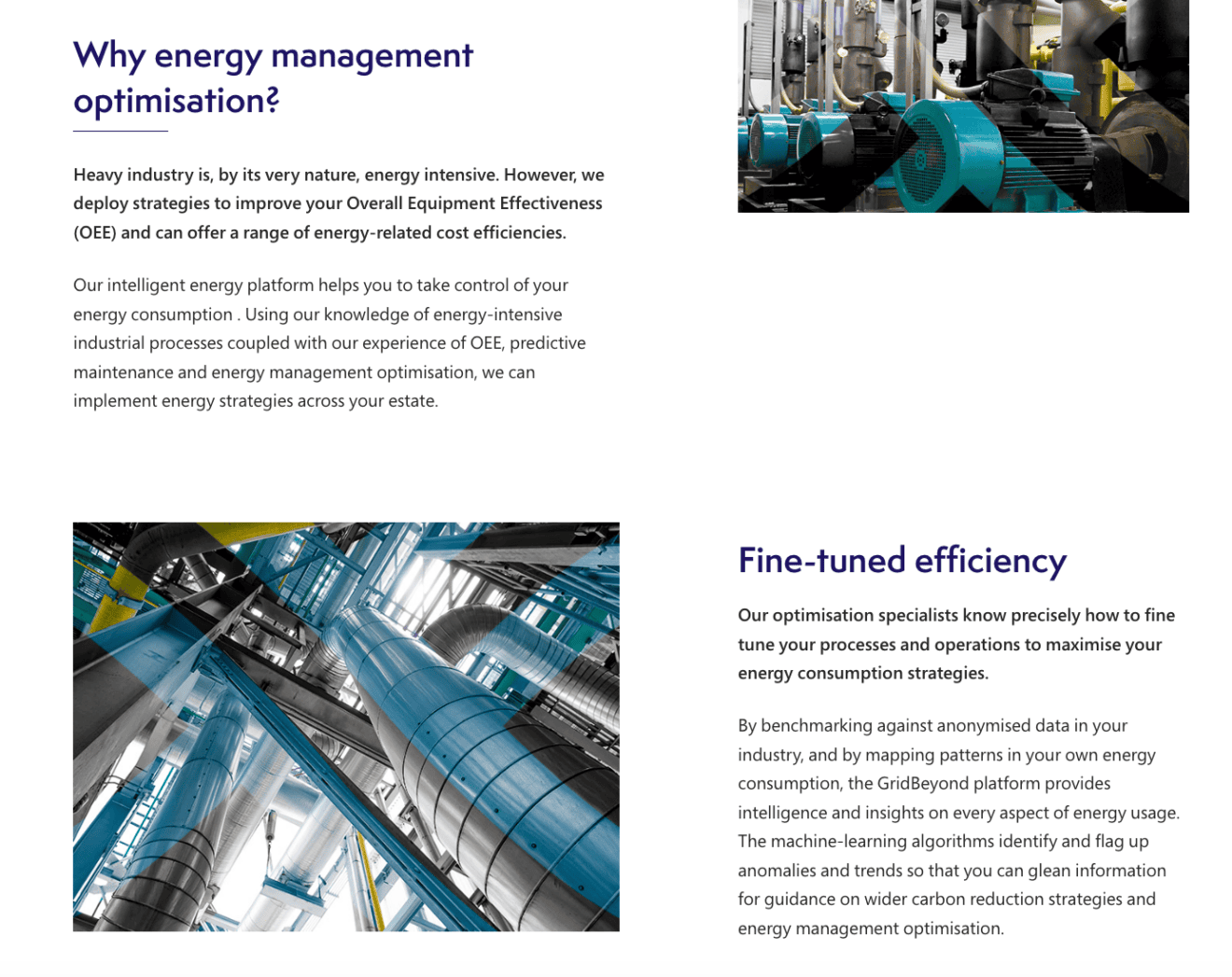
GridBeyond, for example, makes its Energy Management Optimisation service easy to understand. The page explains how the platform reads energy consumption data and uses machine learning to spot patterns and anomalies, then connects that to what the customer gets: predictive maintenance, lower energy costs and a clear view of where the energy goes.
The page closes by calling out the platform’s award-winning technology and linking through to a step-by-step walkthrough of how that tech works. The awards themselves are named elsewhere on the site and confirmed by third parties, including Frost & Sullivan and Energy Risk, so it’s a claim AI platforms can check rather than one they have to take on trust.
That gives AI platforms clear information about how the service works and why it matters, with evidence to back it up.
If you don’t provide that clarity, AI search tools have to piece together their own version of your business from whatever information they can find.
That means losing control of the story before a potential customer has even visited your website – or simply not appearing at all.
Read more: Will AI search stop people visiting my website?
Our framework is deliberately simple:
None of this requires abandoning good SEO or rebuilding your entire marketing strategy around AI-driven discovery.
It means doing the basics unusually well: clearly explaining what you do, proving why someone should choose you, and making sure the same story appears across your wider digital footprint.
Read more: Our framework for building service pages AI search tools can understand and recommend
We’ve unpacked our full findings, rankings, and recommendations in our report.
Download The State of AI visibility in the energy sector 2026 report
Strategic Director
Will helps our clients identify the most effective routes to sustainable commercial growth.
View my other articles and opinion pieces below
A good service page needs to do more than rank in Google. It needs to give AI search tools enough information to understand what you offer, who it is for, and why you should be recommended over someone else. Our research into 86 UK energy organisations points to four things to get right when it comes to AI search optimisation.

Our research into AI visibility in the energy sector found that LinkedIn was the most cited third-party source in AI search answers, appearing in 15.3% of responses. However, organisations with stronger third-party authority were no more likely to appear in AI answers. External coverage helps AI search tools validate your story, but it can’t compensate for a website that doesn’t clearly explain who you are, what you do, and why you should be recommended.

On the Monday evening of London Climate Action Week, with London cooking under a record-breaking heatwave, the most sensible place in the city was underground. We brought a room full of marketers together from across climate tech, clean energy, and sustainability, in an 18th century port cellar, for an eco wine tasting. The wine was […]