
Will Gadsby Peet
Strategic Director
Will helps our clients identify the most effective routes to sustainable commercial growth.
Champagne is heading to England. A recap of our London Climate Action Week 2026 wine night, and why human expertise still beats AI noise in modern marketing.
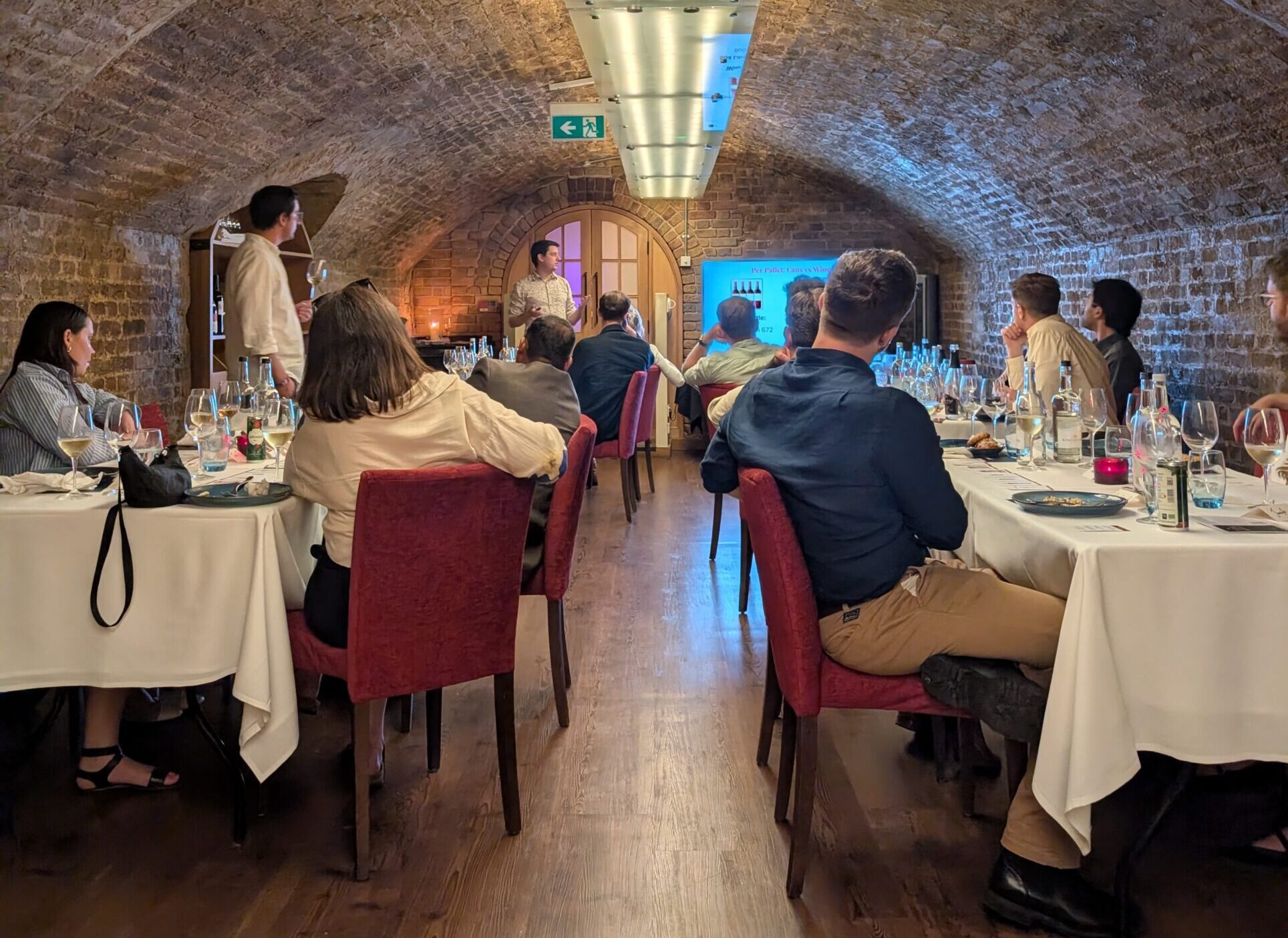
On the Monday evening of London Climate Action Week, with London cooking under a record-breaking heatwave, the most sensible place in the city was underground. We brought a room full of marketers together from across climate tech, clean energy, and sustainability, in an 18th century port cellar, for an eco wine tasting.
The wine was an irresistible excuse. The real plan was to get a lot of clever people in one room for the kind of conversation that never quite happens at a conference, on a webinar, or three replies deep in a LinkedIn comment thread.
We ran it in partnership with Future of Wine and People Planet Pint, wedged into the overlap between London Climate Action Week and English Wine Week. The full name was London Climate Action Wine: Sipping Points, and yes, we were very pleased with ourselves.
Iain Scott and I wanted to put on an evening that didn’t feel like every other industry mixer, and Adam Bastock and Alexander Lewis-Jones from Future of Wine knew exactly how to build it.
Three hours, four incredible wines, tasty food, and a Chatham House Rule so nobody had to perform for the room (or, more to the point, for anyone outside it).
Adam and Alex walked us through the night, and every wine came with a story. Not just flavour and region, but what a warming planet is quietly doing to the people who make it.
Take Champagne. Hotter summers are making it harder to grow the right grapes, in the right place, at the right time, and French law is famously unbudging about the right place. No Champagne region, no Champagne. The catch is that the climate which currently suits Champagne is forecast to drift north over the next few decades, towards southern England. The climate that suits Merlot is heading for Germany. The map is being redrawn, and the grapes did not get a vote.
Some of the big houses are already hedging, quietly buying up vineyards across Kent, Sussex and Essex. Working in this sector, you get used to climate forecasts that feel abstract and far off. A 300-year-old wine region eyeing up the home counties as a bolthole is much harder to file under ‘later’. Grapexit?
We also drank a very good sparkling rosé grown in Tooting, of all places. Several glasses of it, purely in the name of research.
The wine raised the questions. The marketers in the room could not help answering them. The conversation that ran the longest: if a Champagne house can no longer count on Champagne grapes, what does it actually do?
Option one, adapt the product. Grow tougher varieties, ride out the heat, cling to the name. Option two, follow the climate north. Buy land in southern England, keep the iconic bottle and the iconic brand, and quietly accept you can never again call the stuff inside it Champagne. You would be selling a feeling, not a place.
Packaging gave us another great talking point. Glass is one of the worst ways to move wine around if you care about carbon footprint. The industry knows. The customer is the holdout. So how do you convince the market that the good stuff belongs in a can or a carton, when a weighty glass bottle has spent a few hundred years as the ultimate benchmark of quality?
Getting to talk all of this through with some of the UK’s smartest marketers, lots of wine, and no agenda, was the whole point of the evening.
One thing stuck with me on the tipsy train home. Right now, marketers are spending enormous energy understanding how AI is changing the way people search, find things out, and judge a brand. Fair enough. Don’t get me wrong, we spend plenty of our time working on it too given AI-driven discovery is one of our core specialisms.
But a cellar full of sustainability marketers was a good reminder that the old currency still spends. People trust people. Expertise, experience and a proper conversation move things in a way that sheer output never has. The irony is that the signals which earn human trust, real knowledge and a point of view worth hearing, are the same ones AI is increasingly using to decide who is worth citing.
So the brands that get found are not the ones making the most noise. They are the ones with something worth saying. As AI rewires how we get discovered, human expertise, and the occasional evening in a port cellar, only get more valuable.
Stronger marketing is built through shared learning. That, really, is why we run these things. Not for the networking, a word that should probably be banned, but because a sector gets sharper when the people in it actually compare notes.
It was a fun evening. It was also a sobering one. That same morning, Keir Starmer had stood outside Number 10 and announced he was on his way out, leaving Britain to go shopping for its seventh prime minister in a decade. Outside, the city was a furnace. Inside, we were toasting a 300-year-old industry working out how to survive the century.
You don’t need to follow politics closely to feel the mismatch. The most serious problem of our age needs a government that can hold still long enough to lead on it. The world is fairly literally on fire and yet half the headlines covering three days of record breaking June heat pitched it as a fun excuse to head down to the beach.
Which is, in a roundabout way, where marketing comes in. Not to save the planet – let’s not get carried away – but because every low-carbon product, every awkward behaviour change and every climate startup with a better idea still has to convince people to care, and then to act. That’s the job, and it’s a good one to have.
Thank you to everyone who came, and to Adam Bastock, Alexander Lewis-Jones, Future of Wine and People Planet Pint for the wine and the wisdom. We’ll do it again next year.
If you’d like to join us next time, or to talk about how marketing can help your organisation move people to act on climate, get in touch at [email protected].
Strategic Director
Will helps our clients identify the most effective routes to sustainable commercial growth.
View my other articles and opinion pieces below
We analysed 86 UK energy companies to see how ready they are for AI search. The average AI Readiness score was just 36 out of 100, and only one company cleared our benchmark of 70. The biggest issue wasn’t technical performance. Most websites could be accessed by AI platforms, but far fewer gave them enough clarity, evidence, and confidence to recommend the business.

A good service page needs to do more than rank in Google. It needs to give AI search tools enough information to understand what you offer, who it is for, and why you should be recommended over someone else. Our research into 86 UK energy organisations points to four things to get right when it comes to AI search optimisation.
Our research into AI visibility in the energy sector found that LinkedIn was the most cited third-party source in AI search answers, appearing in 15.3% of responses. However, organisations with stronger third-party authority were no more likely to appear in AI answers. External coverage helps AI search tools validate your story, but it can’t compensate for a website that doesn’t clearly explain who you are, what you do, and why you should be recommended.