
Adriana Wertheimer
Senior Digital Strategist
Adriana works with our clients to ensure that their digital activity is focused, effective and well worth their investment.

Make your 2027 digital marketing budget work harder with smarter marketing budget allocation, testing, measurement, and a connected digital marketing strategy.
Digital marketing budgets are under pressure from both sides. Paid media is becoming more expensive and automated. Meanwhile, the number of places where people discover and evaluate organisations is growing.
Going into 2027, getting more from your digital marketing budget can’t just mean lowering your cost per click or finding the cheapest channels. Your marketing budget plan needs to work across a full digital marketing strategy – including search, social, paid media, content, your website, and AI discoverability – with each part supporting a clear commercial outcome.
That connected approach sits at the heart of how we work at exceptional™. Here’s how you can make it work for your organisation.
Book a strategic workshop with exceptional™ to talk about your marketing budget and goals
Your first question shouldn’t be, “which channels should we spend on?”
It should be, “what are we trying to achieve?”
That could mean reaching a new audience, generating qualified leads, increasing sales, improving retention, or making your organisation more visible when potential customers are researching a problem.
Each outcome needs a different mix of activity and a different measure of success.
At exceptional™, we use our model – the Digital Marketing Flywheel – to connect activity across the customer journey rather than treating each channel as a separate pot of money.
Your budget works harder when those activities support one another.
For Metis, for example, we turned evidence from a live solar and battery retrofit programme into stakeholder-led content, then used that content across organic and paid social to build credibility with local authorities and generate demand. That connected approach helped produce four council-level leads in the first two weeks, while LinkedIn followers grew by 302%.
Cost per lead is useful. If you spent £5,000 and generated 50 leads, for example, your CPL was £100.
That tells you how efficiently the campaign generated leads… but it doesn’t tell you whether those leads were any good.
We saw that distinction in one of our recent client campaigns. Their goal was to attract senior women in finance who were a strong fit for their career development programme. The campaign generated 43 leads at £54.70 each – around 54% below the industry benchmark – but the more important result was who those leads were. 95% worked in finance, while 90% held Senior, Manager, Lead, Head, or Director roles.
Analytics and measurement need to connect marketing performance with the people and outcomes your organisation actually values. A higher CPL can be completely acceptable if it brings you better prospects. A cheap lead that never progresses is still wasted budget.
When a campaign is underperforming, your first response shouldn’t be to put more budget behind it and hope that fixes things.
Start by looking at what happens after somebody responds to your campaign:
Paid media only works properly when the audience, proposition, creative, landing experience, and measurement work together. If one part of that journey is creating friction, increasing spend can just mean paying to send more people into the same problem. That’s why we look beyond bids and budgets to the full experience after the click.
Sometimes the best way to make your media budget work harder isn’t to buy more attention. It’s to waste less of the attention you already have.
Reporting should help you make the next decision, not just explain the previous month.
That means looking beyond overall campaign performance and asking which audiences, messages, locations, and creative ideas are driving the response you actually want.
In another recent campaign, we supported a dental brand looking to build local awareness and generate more patient demand across key practice locations, did exactly that. Different orthodontic audiences responded to different messages: adults engaged particularly well with consideration-led messaging around discreet treatment, specialist care, and finance, while parents responded better to more direct messaging around faster access to treatment. Performance also highlighted particularly strong adult engagement in Newcastle and parent engagement in York, giving us clearer evidence of which audiences, messages, and locations future budget should prioritise.
Those findings do more than prove whether the campaign worked. They tell you where future budget has the strongest opportunity.
This is also where human insight really matters in marketing. Dashboards can show what happened, but customer conversations, sales feedback, reviews, and real audience behaviour can help explain why.
The strongest approach combines the two, turning what you learn about your audience into something you can test.
If every pound of your digital marketing budget is committed to repeating activity that already exists, it becomes difficult to improve.
I’d always keep some room for controlled testing.
That could mean trying a different proposition, a new audience, an unusual creative idea, a different landing-page journey, or a channel that hasn’t previously received much investment.
The important part is that the test has a reason behind it.
Start with an audience or performance insight, create a clear hypothesis, and decide what result would justify investing more. That gives new ideas the opportunity to prove themselves without asking the business to gamble the whole budget.
As platforms automate more of campaign delivery, this kind of strategic testing becomes more important, not less.
The platforms can make more decisions for us. We still need to decide which outcomes, audiences, and ideas are worth pursuing.
Paid media is only one way someone might encounter your organisation.
Your audience might find you through Google, see a colleague share one of your articles on LinkedIn, come across a trade publication mentioning you, or ask ChatGPT, Gemini, or another AI platform which providers are relevant to their problem.
That changes what it means to invest in visibility.
Our AI-driven discovery work focuses on making organisations easier for AI platforms to find, understand, and represent accurately. That means thinking about your content, technical foundations, structured data, expertise, and the wider sources that reinforce what you say about yourself.
That investment can support other channels too.
A useful service page can improve traditional search visibility, give a paid campaign a stronger destination, provide material for social content, and give AI platforms clearer information about what you do.
For 2027, the question isn’t just “how much should we spend promoting this?”
It’s also “how easy are we to discover and choose when someone is already looking?”
One of the easiest ways to waste budget is to let every platform mark its own homework.
Paid media reports clicks and conversions. Social platforms report engagement. Search tools report rankings, impressions and clicks. Website analytics report sessions.
All of those numbers can be accurate while still giving you an incomplete view of what’s creating demand.
Our approach to analytics and measurement is to connect performance across the journey, from discovery and engagement through to conversion, retention, and advocacy.
That helps show where people are dropping out, which activity is creating momentum, and where investment should change.
You’re unlikely to have a perfect attribution model for every customer journey. You can have enough evidence to make better overall decisions.
The strongest digital marketing budget isn’t the one that looks perfectly allocated on 1st January.
It’s the one that gets smarter as you learn.
Start with the outcome you need. Give each part of your marketing a clear role. Measure the quality of the result, not just the quantity. Remove friction before paying for more traffic. Keep testing new ideas, and make sure your investment reflects all the places your audience now searches, scrolls, and asks.
Then use what you learn to decide where the next pound should go.
That’s how you make your digital marketing budget work harder in 2027.
Book a strategic workshop with exceptional™ to talk about your marketing budget and goals
Senior Digital Strategist
Adriana works with our clients to ensure that their digital activity is focused, effective and well worth their investment.
View my other articles and opinion pieces below
In my previous article – Become your own benchmark: why B2B marketing needs better measures of success – we looked at why B2B digital marketing benchmarks can be useful, but limiting. They help senior marketers within organisations – or B2B digital marketing agencies like exceptional™ – to understand the landscape, defend performance and create context. […]
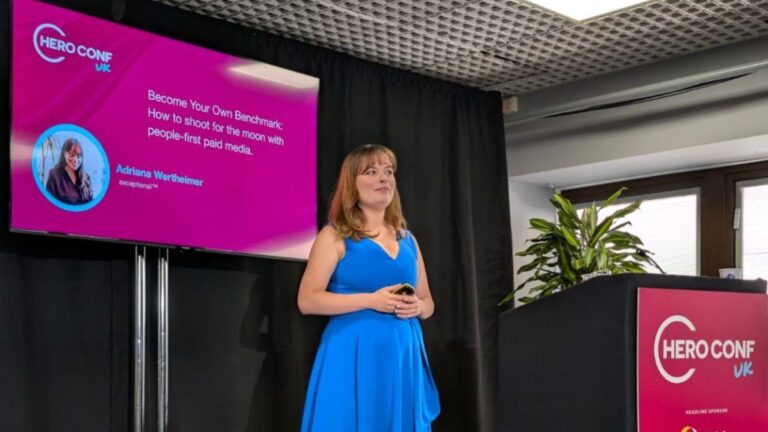
Benchmarks are useful in digital marketing. They offer reassurance: a way to make performance feel measurable, comparable and defensible. Marketing benchmarks help answer the question every marketer has heard in one form or another: “Is this good?” As marketers, we review the stats, look at whether we are above or below the industry average, and […]

It’s easy to assume that rising ad costs are the result of competition. More advertisers. Higher demand. Increased pressure on auctions. But in 2026, something more structural is happening. A series of Google Ads updates and Meta platform changes are directly increasing how much advertisers spend – and how that spend is controlled. These are […]

This guide breaks down all the social media image and video sizes you need to know, including LinkedIn, Instagram, Facebook, X (formerly Twitter), YouTube, Pinterest, TikTok and Google Business Profile.