
Adriana Wertheimer
Senior Digital Strategist
Adriana works with our clients to ensure that their digital activity is focused, effective and well worth their investment.
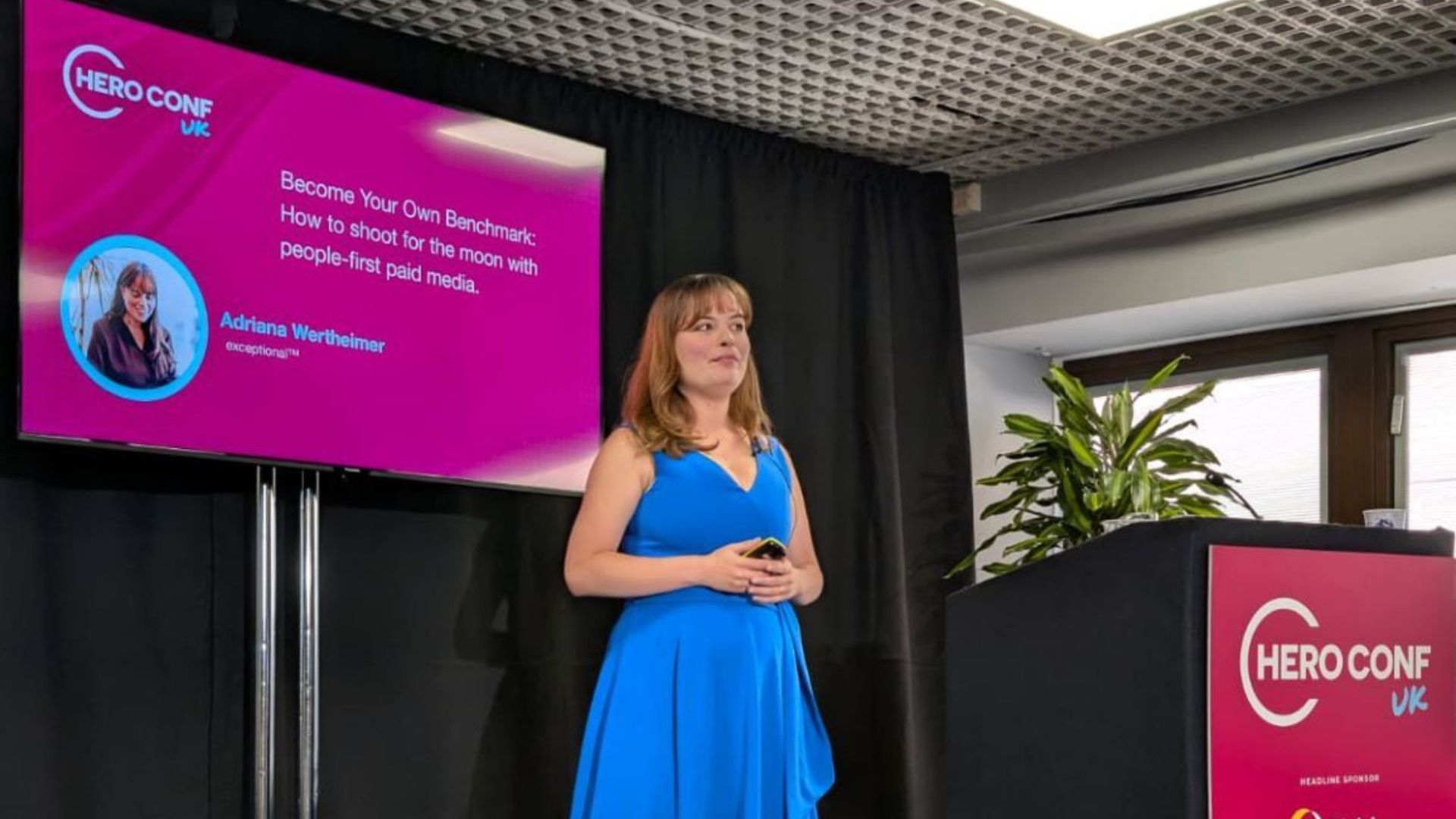
Adriana Wertheimer, Senior Digital Strategist at exceptional™, explores how human insight helps B2B digital marketing agencies improve campaign performance beyond benchmarks.
In my previous article – Become your own benchmark: why B2B marketing needs better measures of success – we looked at why B2B digital marketing benchmarks can be useful, but limiting. They help senior marketers within organisations – or B2B digital marketing agencies like exceptional™ – to understand the landscape, defend performance and create context. However, industry averages should not become the ceiling for ambition.
There’s a natural follow-up question if you are not simply chasing the benchmark, what should you be doing instead?
The answer is not to ignore data, abandon best practice or start making decisions based on gut feelings – a phrase that has caused many a marketing budget to quietly leave the building. The answer is to add an additional layer that many campaigns are missing: human insight.
Human insight is the difference between knowing who your audience is on paper and understanding how they actually think, behave and buy. It’s what turns a technically sound campaign into one that feels relevant enough to make someone stop, pay attention and take action.
For senior marketing leaders, this is where the opportunity sits – not in asking teams to be “more creative” in a vague, slightly terrifying way, but in creating a practical process that helps insight shape messaging, creative and testing from the start.
Marketing dashboards are brilliant at telling us what happened in the past tense. They can show which channel drove the click, which creative had the stronger CTR, which landing page converted and which audience segment was most efficient.
What they are less good at telling us is why someone cared in the first place.
If campaign performance is flat, the temptation is often to stay inside the dashboard and keep pulling technical levers: adjust the budget, refresh the audience, change the paid media bidding strategy or give the algorithm “more time.”
Sometimes those changes are necessary. But if our campaign is reaching the right people and still not moving them to act, the issue may not be distribution. It may be relevant.
That is where you should shift the conversation. Instead of just asking, “How do we optimise this campaign?”, ask: “What do we know about the person we are trying to influence that isn’t already obvious in the media plan?”
Most marketing teams have some version of an audience profile. It may include job titles, sectors, company sizes, pain points and buying triggers. Useful? Yes. Complete? No.
Neat profiles like these can make audiences sound more rational and polished than they really are. A buyer may be listed as “Founder, high net worth, interested in property investment”, but that does not necessarily tell you what their day looks like, how they make decisions, or what will feel immediately familiar to them.
That gap is where better creative often lives.
In one property investment campaign I worked on, the original creative was a polished, high-production video. It looked premium, followed the rules and felt reassuringly “right” in a stakeholder meeting. The only issue was that it did not generate enough closed deals.
The creative that outperformed it was a handwritten Post-it note with the deal written plainly. Not exactly Cannes Lions material, unless the stationery category has become more competitive than I realised. But it worked. In fact, it brought in 45% more closed deals than the professional video.
The reason was simple: it reflected the audience’s lived reality. Property investors are often moving between viewings, calls, spreadsheets and site visits. A quick handwritten note felt more immediate and familiar than a professionally produced video.
The takeaway is not that every brand needs a Post-it note. The takeaway is that your best-performing idea may come from understanding the customer’s real context – their actual lives – not just their sterile profile.
The most common mistake with human insight is treating it as something broad: “Our audience wants to save time” or “Our buyers care about growth”. Those things may be true, but they are rarely distinctive enough to create a stronger campaign.
Good human insight should make the work more specific. It should influence the words you use, the setting you show, the format you choose, the problem you lead with, or the behaviour you reflect back to the audience.
I once worked on a campaign for a print publisher. The existing paid social activity was clean, branded and commercially sensible, but performance had started to plateau.
Rather than pushing harder with the same assets, we looked at how people were naturally engaging with the product in the real world. What became clear was that the product was not only something to read. It was also a visual cue: part of a coffee table, a lifestyle moment, an identity signal.
That insight changed the creative direction. Instead of relying only on polished product shots, the campaign tested more natural, lifestyle-led imagery showing the product in environments where the audience already imagined it belonging. When that insight was applied to paid social retargeting, conversion rates increased.
The lesson is simple: human insight does not weaken brand standards. Done well, it makes the brand feel more relevant.
The challenge with human insight is that it can sound purely subjective – unless there’s a process behind it. Senior leaders don’t need more random creative opinions flying around the room. Most marketing meetings already have enough of those, usually beginning with “I’m not the target audience, but…”
A better approach is to make human insight part of the testing process.
Start with one audience segment or campaign where performance has plateaued. Ask the team to gather three types of input before developing new creative:
From there, turn the insight into a small number of testable creative hypotheses. For example: “If we use the language prospects use on sales calls, the ad will feel more relevant.” Or: “If we show the product in the environment customers associate with ownership, retargeting performance will improve.”
This turns human insight from a nice idea into something measurable.
The easiest way to kill a more interesting idea is to ask an organisation to bet the entire budget on it.
Most senior marketers don’t need a dramatic creative revolution. They need a controlled way to test whether a more audience-led approach can improve performance.
Take 10% of the budget, or 5%, or even 1%, and ring-fence it for human insight-led testing. This is not a licence to be random. It is a structured space for ideas that are grounded in customer understanding but may not look exactly like the existing playbook.
The benefit is twofold. It reduces risk, which makes approval easier, and it creates evidence, which makes scaling easier. Once a test shows stronger engagement, better conversion rates or improved commercial outcomes, the conversation changes. It is no longer “this feels brave”. It becomes “this has earned more budget”.
That distinction matters. Senior marketers are often not short of ideas. They are short of internal permission. A small, well-designed test can create that permission.
Human insight should not sit in a workshop deck or disappear into a persona document that nobody opens after the initial presentation. It should actively shape the campaigns you build, the creative you approve and the tests you prioritise.
The practical takeaway is not to replace data with instinct. It is to combine performance data with real customer understanding, so that campaigns are not only well targeted, but genuinely relevant.
For senior marketing leaders, there are four useful questions to take back to the team:
The brands that outperform are not always the ones with the biggest budgets or the most polished creative. They are often the ones that understand their customers more clearly, test more intelligently and have the confidence to act on what they learn.
That is how human insight becomes more than a creative idea.
It becomes a performance advantage.
Book a strategic workshop with exceptional™ to talk about your marketing benchmarks and beyond.
Senior Digital Strategist
Adriana works with our clients to ensure that their digital activity is focused, effective and well worth their investment.
View my other articles and opinion pieces below
Benchmarks are useful in digital marketing. They offer reassurance: a way to make performance feel measurable, comparable and defensible. Marketing benchmarks help answer the question every marketer has heard in one form or another: “Is this good?” As marketers, we review the stats, look at whether we are above or below the industry average, and […]
It’s easy to assume that rising ad costs are the result of competition. More advertisers. Higher demand. Increased pressure on auctions. But in 2026, something more structural is happening. A series of Google Ads updates and Meta platform changes are directly increasing how much advertisers spend – and how that spend is controlled. These are […]

This guide breaks down all the social media image and video sizes you need to know, including LinkedIn, Instagram, Facebook, X (formerly Twitter), YouTube, Pinterest, TikTok and Google Business Profile.