
Charlie Stewart
Senior Content Strategist
Charlie brings his creative flair developing content and copywriting across all of our campaigns.

How do you optimise your website for AI? Improve AI visibility with focused service, audience and article content that makes your site easier to understand.
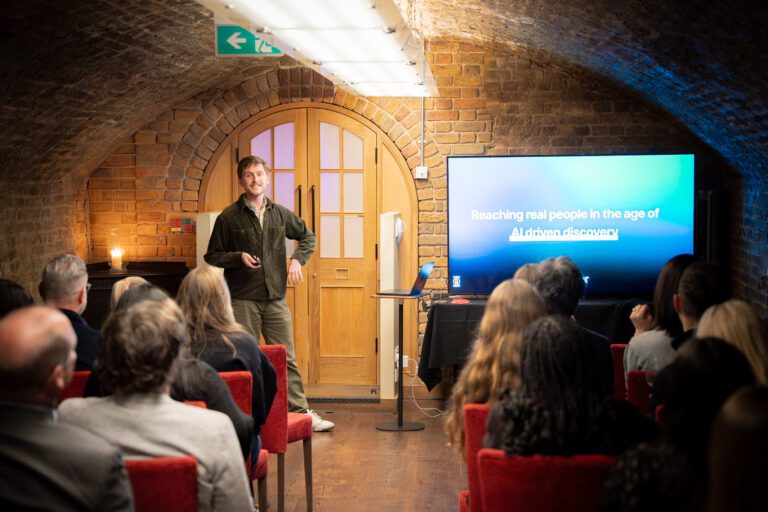
Sometimes it can be tempting to think of your website like a stage.
It’s your big opportunity to stand in front of the whole internet and explain what you do, who it’s for, and why it matters.
That sounds great. But it’s not how search works, and it’s not how your site should either.
Your audience isn’t all in one place ready to listen. They’re scattered across search engines, social platforms, and AI tools, asking different questions about different problems at different stages of their buyer journey.
Think of your website like a tree.
You need a strong trunk as a foundation – some core pages that explain the business clearly – but you also need roots spreading out into more specific services, audiences, use cases, and questions. You need to meet the different parts of your audience where they actually are and give each of them a clear and distinct route back to you if you’re going to grow.
That was already the foundation of good content back in the day, but with the rise of AI search, it’s becoming much more important.
Across multiple studies and our own research, a consistent pattern emerges: focused, specific content tends to perform better than asking broad, catch-all pages to do too many jobs.
Book a strategic workshop with exceptional™ to talk about your website content
Don’t take my word for it. Let’s look at three studies.
AirOps found that, among pages already well matched to the original query, more focused content was cited more often by ChatGPT. Pages covering around a quarter to half of the related subtopics had a 38.2% citation rate, compared with 34% for pages trying to cover all of them.
Cyrus Shepard found a similar pattern at website level. Looking at research across more than 400 websites gaining and losing Google traffic, tight topical focus was one of the key characteristics associated with the sites performing better. Broad, easily replaceable content is becoming more vulnerable, while focused, genuinely useful content is becoming more valuable.
And it isn’t just about search trends. Markettailor’s platform data found that visitors shown role-relevant content were 2.7x more likely to request a demo.
Put together, the practical lesson isn’t that you need to make every page narrower. It’s that you shouldn’t try to make a small number of pages do too many jobs.
If different services, audiences, or important use cases need genuinely different information, give them their own pages. Then use articles and guides for the narrower questions people ask around them. That gives AI search a clearer answer to match to a given query – and gives the person arriving on your site something that immediately feels relevant to them.
When we analysed 86 UK energy organisations, the companies best-prepared for AI search were already giving important services and audiences their own dedicated content.
Anesco, for example, has separate pages for project development and battery storage rather than forcing both into one generic proposition page. Pod does something similar by audience, with fleet charging content built specifically around organisations moving commercial fleets to EVs.
That becomes particularly useful as people start asking more specific questions.
Sure, a broad search like “who provides EV charging?” only needs a broad answer – but with AI search tools, people are asking longer, more complicated questions.
With a question like “which EV charging provider can support a commercial fleet across depots and drivers’ homes?”, the buyer has a specific use case, and both they and the AI tools they’re using need to know whether a provider can actually support it.
A generic EV charging page might show an AI search tool that you offer charging. A distinct, dedicated fleet charging page can show that you understand fleet operators, support depot and home charging, and can handle the practical requirements that come with that.
That gives both the buyer and the AI search tool a much clearer reason to see the page as relevant.
That was one of the clearest patterns we found across the best-prepared energy websites: they made it unmistakably obvious what each offer was, who it was for, and when it was relevant.
The answer isn’t to create a new landing page for every question somebody might ask.
It’s to avoid packing all the info about your company onto a few pages, and to decide what deserves its own core page, and what should be supporting content.
If, for example, you’re in the energy sector and offer solar, battery storage, EV infrastructure, and retrofit, those services are different enough to need their own pages rather than being squeezed onto one generic “energy solutions” page.
If local authorities and commercial property owners have different needs, buying processes, or reasons for choosing you, they may need different pages too.
Someone asking “can employees charge company EVs at home?” probably doesn’t need another permanent page in your main website navigation. They need an article that answers that question properly, then points them towards your commercial fleet charging service.
These are useful when someone needs proof that you’ve done the work before, or help understanding how different options compare.
Your core website explains what you do and who you do it for. Your ongoing content answers the more specific questions people ask around it.
The more clearly you separate what your core pages, audience and service pages, articles, and case studies are there to do, the easier your website is for people to navigate – and for AI search tools to understand.
Book a strategic workshop with exceptional™ to talk about your website content
Senior Content Strategist
Charlie brings his creative flair developing content and copywriting across all of our campaigns.
View my other articles and opinion pieces below
You don’t need me to tell you that AI is completely changing search. Every B2B brand wants to know how to appear in AI answers. It’s easy to see why. So there are two questions every B2B needs to answer before they start thinking about AI-driven discovery, AI SEO, GEO – whatever you want to […]
“Thought leadership” has become an essential part of B2B marketing. Ever since Google’s helpful content update, it’s been more important than ever for your organisation’s team members to be producing high-quality, informed content in their areas of expertise. What is thought leadership? Articles, LinkedIn posts, blogs, videos – all of this comes under that umbrella. […]

Senior Content Strategist Charlie Stewart explains how B2B firms can create authentic, story-driven marketing content that resonates with audiences and builds trust in the age of AI.

Charlie Stewart shares how video content can connect with your audience at the exact moment they’re searching – and why it’s time to treat video as a vital search asset, not just a creative one.