
Anna Corbett
Director of Client Success
Anna is responsible for all client delivery, and is our resident data and analytics lead.

See what the 10 best-prepared UK energy organisations have in common, from clearer service pages and defined audiences to stronger proof and outcomes.
We analysed 86 UK energy organisations to understand how prepared they are for AI-driven search. Looking at the ten highest-scoring companies, five trends stand out: they describe their services clearly, give important offers dedicated space, define who those offers are for, connect them to tangible outcomes, and provide evidence to support their claims.
We used our AI Performance Analyser to score 86 UK energy organisations across four areas: how accessible their website is to AI search tools, how often they appear in relevant AI answers, how they perform across the prompts we tested, and the strength of the credibility signals supporting them.
Each area receives a score that contributes to their overall AI Readiness score, marked out of 100.
The ten highest-scoring organisations were:
The sector average was just 36/100. So what are the companies nearer the top actually doing differently?
Looking across their websites, five patterns come up repeatedly:
The strongest sites don’t make you decode the proposition before you understand the service.
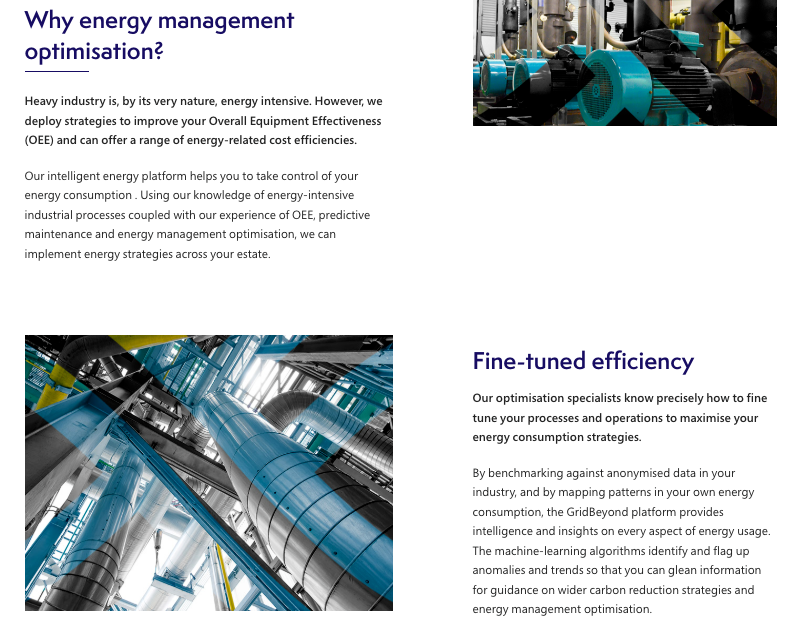
GridBeyond is a good example. Its Energy Management Optimisation page explains how the service works in practice. It describes how the platform benchmarks energy use against anonymised industry data, maps patterns in a customer’s own consumption, and uses machine learning to identify anomalies and trends. It then connects those insights to practical outcomes such as predictive maintenance, improved operational efficiency, lower energy costs, and wider carbon reduction. That gives AI search tools a clear picture of the service, the information it uses, and what a customer can expect to get from it.
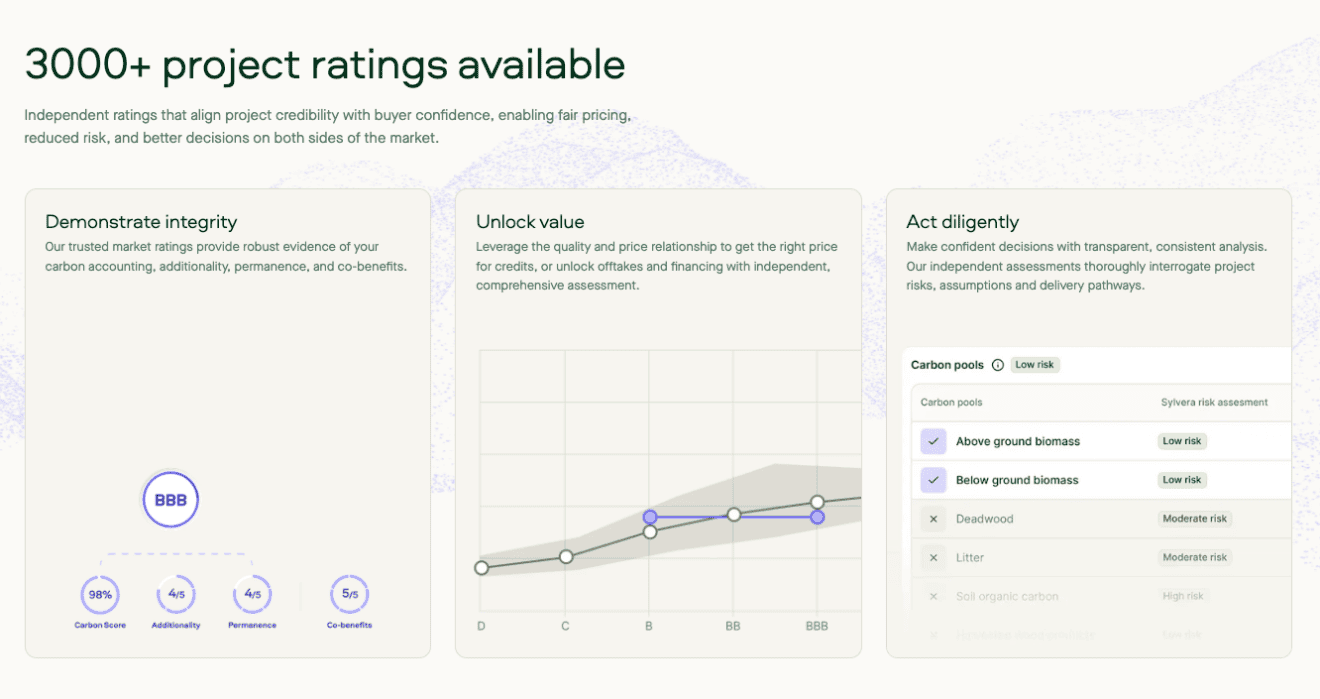
Sylvera takes a similar approach with its Ratings product. The page explains what the product is and what it helps buyers do: use independent ratings to assess carbon credit quality, reduce risk, support fair pricing, and make better decisions. It then breaks that down further, showing how ratings assess areas such as carbon accounting, additionality, permanence, and co-benefits, while helping users understand pricing and interrogate project risks. That gives AI search tools clear information about both the product itself and the decisions it is designed to support.
Both pages make the buying logic explicit. They don’t just describe a capability – they show what the service assesses or changes, why that matters, and what decision or outcome it supports. That gives AI search tools a much stronger basis for deciding when the company is relevant to a specific question, which is ultimately what visibility in AI search depends on.
Review your most important product and service pages and ask whether someone unfamiliar with your organisation could quickly understand what the offer does and how it works.
If the answer is no, AI search tools may have the same problem. Replace broad proposition language with specific information they can use to understand the service and recognise when it’s relevant.
Read more: How we measure what AI is saying about your organisation
The top sites don’t try to squeeze the whole business into one broad capabilities page.
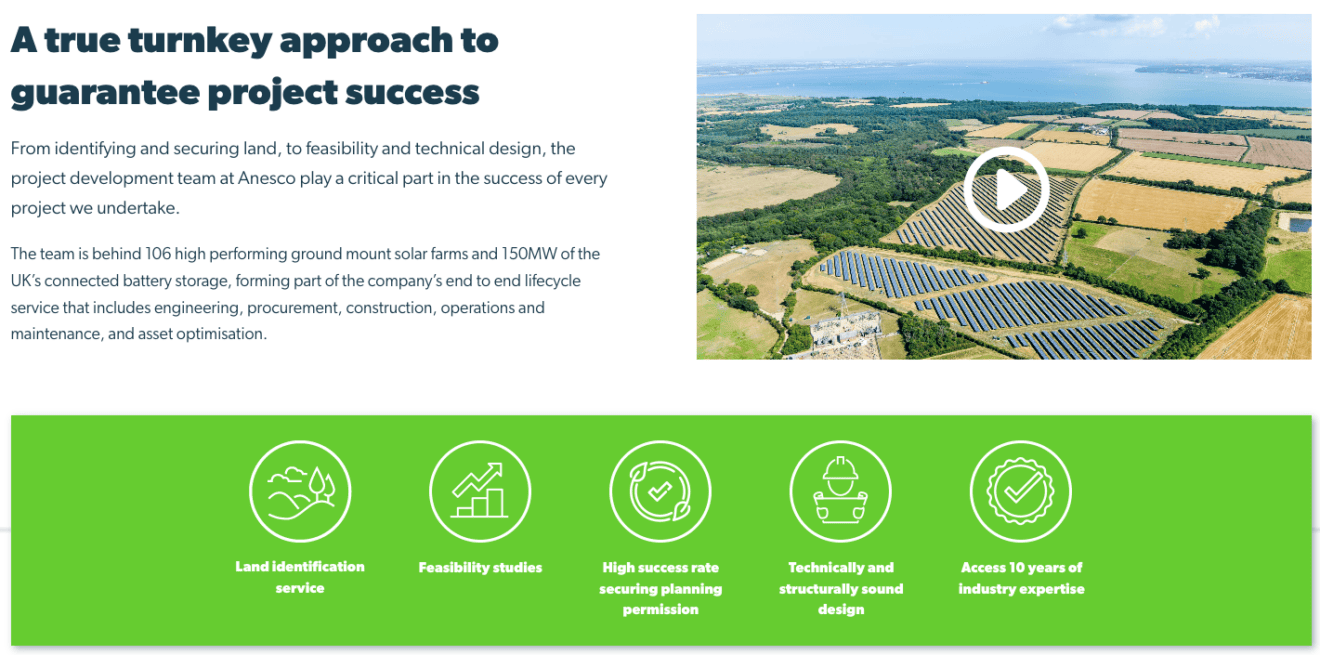
Anesco shows why dedicated service pages matter. Its Project Development page explains the service in clear stages, from identifying and securing land through feasibility studies, planning permission, and technical design. It backs that up with evidence too, including 106 ground-mount solar farms and 150MW of connected battery storage. That gives AI search tools a much fuller picture of what “project development” means, what Anesco actually does within it, and the experience behind the offer.
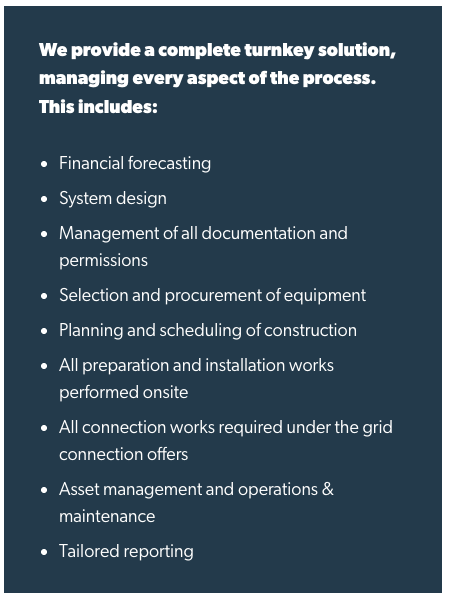
Battery storage is handled separately. Its Utility Scale Battery Storage page contains a block listing financial forecasting, system design, equipment procurement, construction, grid connection, asset management, maintenance, and reporting.
Making those offers distinct gives AI search tools a deeper source of information for each service instead of asking it to unpack a broad “end-to-end” proposition.
Anesco shows the difference between making a page accessible and making it useful to AI search tools. Technical setup gets AI crawlers onto the page. Detailed service content helps give it enough information to understand the offer and match it to a relevant question.
Look for important services that are only mentioned briefly on broader capability pages. If a service has its own audience, use case, or process, it may need its own page.
That gives you enough space to explain the service properly and gives AI search tools a clearer source to draw on when someone asks about it.
Read more: A framework for building service pages AI actually wants to recommend
Another recurring pattern is audience specificity.

Pod’s fleet charging page makes the audience clear before you get into the detail: this is a solution for organisations transitioning fleets to electric vehicles, or, as the page succinctly puts it, “Home EV charging for your drivers.” The rest of the page stays anchored to that buyer’s needs, covering depot, workplace, home, and public charging, operating costs, fleet expense management, charging data, infrastructure capacity, and the practicalities of scaling an EV fleet.
That specificity gives AI search tools far more to match against a detailed question. If someone asks for a charging provider that can support a commercial fleet across depots and drivers’ homes, for example, the page contains explicit evidence that Pod addresses that scenario. It doesn’t have to infer the audience from a generic EV charging proposition.
That becomes increasingly important as AI searches become more specific to the buyer’s circumstances, rather than simple searches for a category of company.
Be explicit about who each service is designed for. Name the types of organisations, assets, situations, or problems it is built around.
That makes it easier for AI search tools to connect your offer with a specific buyer question, rather than having to infer whether you’re relevant.
Read more: Will AI search stop people visiting my website?
The better-prepared companies consistently connect capabilities with outcomes.
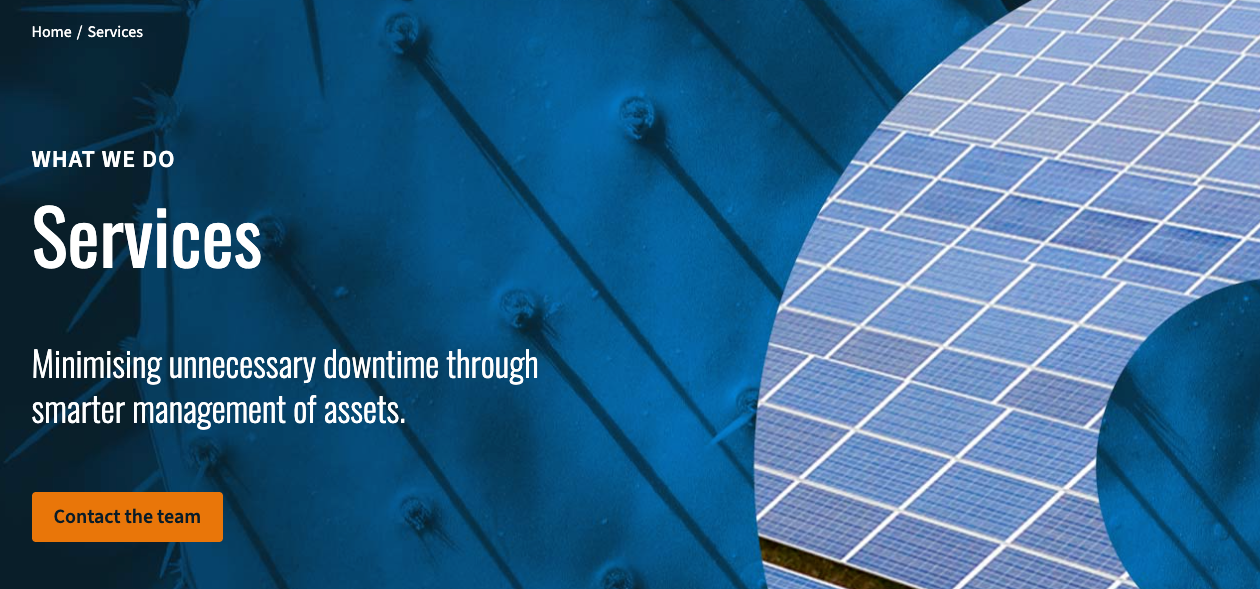
RES’s main services page leads with the business problems its services are intended to solve. It talks about minimising unnecessary downtime and maximising asset value. Its operations and maintenance offer then gets more specific, explaining that the service is designed to reduce lost production, unplanned downtime, component failures, and costs.
That gives AI search tools something different from a list of capabilities. They can connect the service to the reasons a customer would buy it. If a user asks how to reduce downtime or improve the commercial performance of a renewable asset, those outcomes create a clear link between the question and RES’s offer.
A feature tells AI search tools what a service contains. An outcome helps them understand why that service might belong in an answer.
Don’t leave the benefit for the reader to work out. Explain what each important feature or capability actually helps the customer achieve.
That creates a clearer link between what you provide and why someone would choose it – useful information when AI search tools are comparing different providers.
Read more: Evidencing humanity: how B2B brands get found and chosen in AI search
The final pattern is proof.
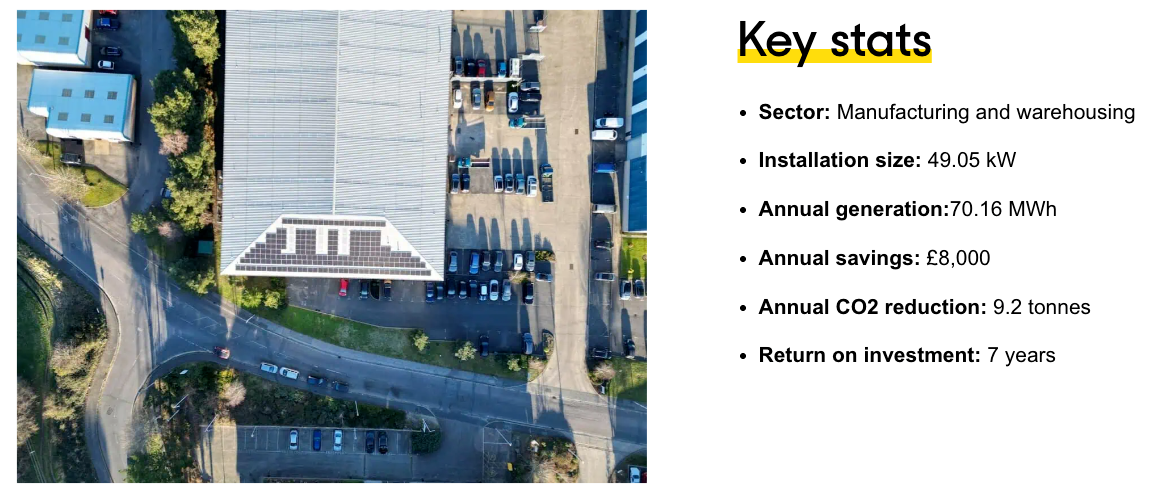
This is the one area where a good case study can be more useful than another service page, as it helps brands evidence why they should be chosen.
Good Energy’s case study for manufacturer bigHead, for example, doesn’t just say that commercial solar can reduce costs and carbon. It gives concrete proof of the result: a 49.05kW installation generating 70.16MWh a year, saving the customer £8,000 annually, cutting CO2 by 9.2 tonnes a year, and delivering a seven-year return on investment.
That turns a marketing claim into evidence an AI system can use. Instead of having to take “we help businesses save money with solar” at face value, it has a real customer, a defined project, and measurable results. Those details are particularly useful when an AI tool is trying to compare providers or explain why one might be relevant to a buyer.
Have you done this before? For whom? At what scale? What happened?
Those are useful questions for a potential customer. They’re useful questions for AI search tools too.
Support important claims with evidence wherever you can. Named customers, specific projects, measurable results, and clear examples all show that you’ve delivered what you say you can.
That gives AI search tools something concrete to use when deciding whether your organisation is a credible answer, rather than relying on the claim alone.
None of these patterns amount to a secret formula for AI search. Technical SEO remains important, but our findings show why it isn’t enough on its own.
The more useful lesson from the top ten is that they make their businesses easier to understand. They use specific language, explain important services properly, define who they help, connect those services to outcomes, and give those claims something concrete to stand on.
That is a much better place to start than looking for an AI optimisation trick.
Download The state of AI visibility in the energy sector 2026 report.
Director of Client Success
Anna is responsible for all client delivery, and is our resident data and analytics lead.
View my other articles and opinion pieces below
Will AI search mean people stop visiting your website? The honest answer is… yes, in some cases. AI-generated answers are already changing how people use search. Pew Research Center found that users clicked a traditional Google result on 8% of visits where an AI summary appeared, compared with 15% of visits where there was no […]

AI browsers are going to change how people interact with websites. Google is rolling out Gemini in Chrome to Mac and Windows desktop users in the US. This means users can ask Gemini to clarify complex information on any webpage they’re reading. Google has also introduced the ability to ask questions about the current page […]

When I was three, my brother had a stick. Not just any stick – a very good stick. I wanted it with the full commitment only a three-year-old can bring to something they have no practical use for. There were a few issues. It was too big for me, it belonged to my brother, and […]

It’s no secret that users are increasingly turning to AI search platforms such as ChatGPT, Google’s AI Overviews and Perplexity to ask questions about organisations, industries and services. Instead of browsing links, they receive a single summarised answer built from multiple sources across the web. While developing our AI Performance Analyser, we began noticing a […]