
Anna Corbett
Director of Client Success
Anna is responsible for all client delivery, and is our resident data and analytics lead.
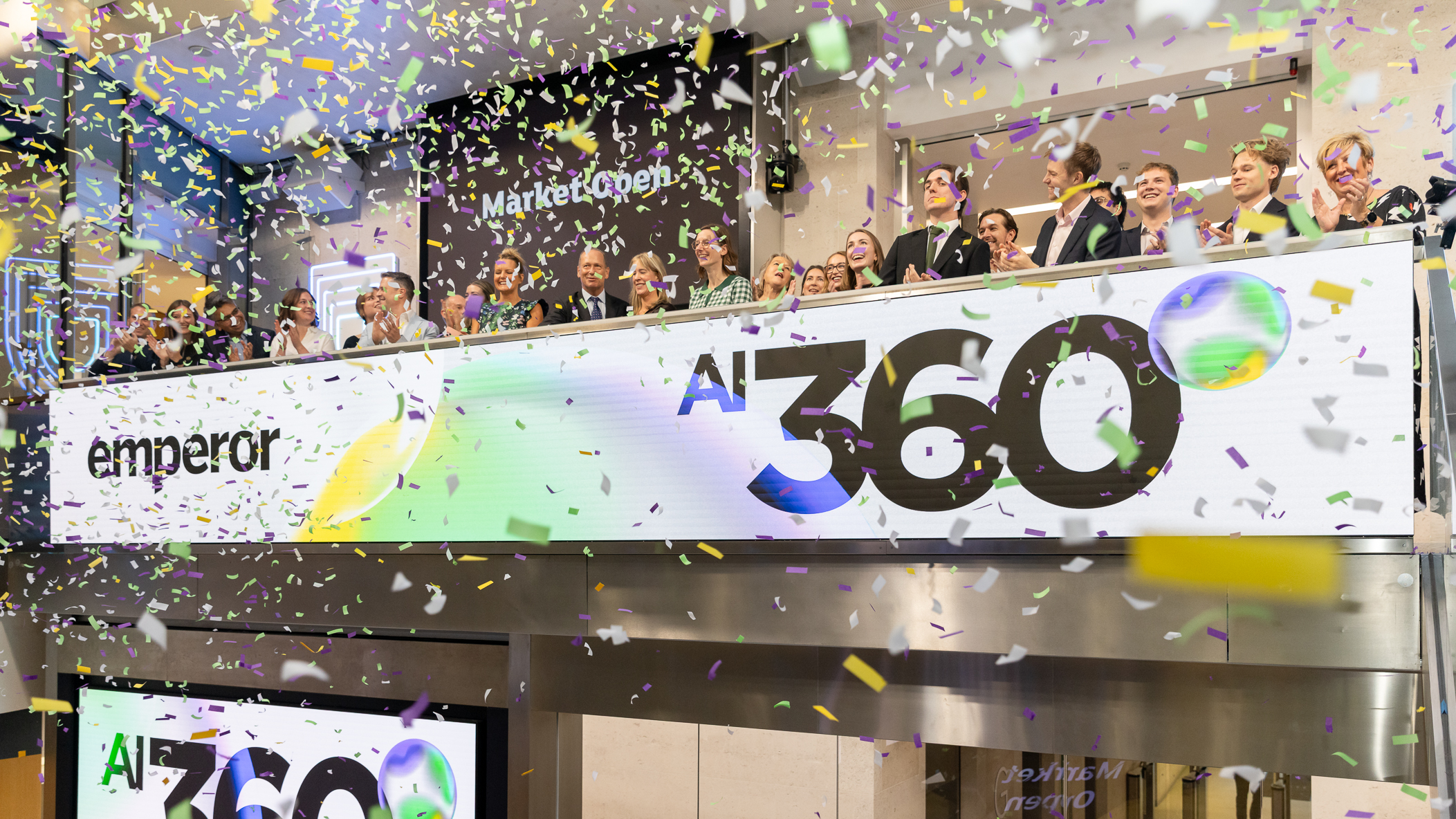
Discover what the AI360 Index reveals about nearly 300 FTSE 350 companies, from branded versus unbranded AI visibility to readiness, rankings and sector trends.
We analysed nearly 300 of the UK’s largest companies to understand how visible, accurate and accessible they are across leading AI platforms. The findings reveal some significant gaps between being known by AI and being part of the conversation.
When someone asks ChatGPT about your organisation, you’d expect it to know who you are. But what happens when they ask which companies are leading your sector, delivering on their sustainability commitments or demonstrating the clearest strategies for growth?
Will yours be part of the answer?
That’s one of the questions we wanted to explore when developing the AI360 Index in partnership with Emperor.
We’ve analysed nearly 300 FTSE 350 companies across leading AI platforms, including ChatGPT, Gemini, Perplexity, Copilot and Google’s AI search experiences, to establish how effectively they’re being represented.
The average score was 67.7 out of 100, with just two companies achieving our ‘excellent’ benchmark.
But the most interesting finding wasn’t necessarily who came top. It was the difference between how AI responds when it already knows which company to look for and when it’s asked to identify the most relevant companies itself.
We developed the AI360 Index to give organisations a benchmark for understanding their performance in AI search and identifying opportunities to improve.
Each company received a weighted score out of 100, based on three areas:
For visibility, we tested 20 standardised prompts per company across six AI search experiences, covering both branded and non-branded questions. Each company was assessed through approximately 600 to 1,300 AI interactions.
Accuracy was assessed through AI-assisted comparisons with annual report information, while readiness was evaluated through a technical assessment of each corporate website.
The research focused specifically on corporate communications and audiences such as investors, journalists and prospective employees, rather than consumer products or services. Some FTSE 350 companies were excluded where their corporate websites were not relevant to the assessment or readiness could not be reliably evaluated.
These scores provide a useful benchmark, rather than a definitive measure of every possible AI response. AI answers vary, and individual accuracy findings should be investigated in more detail before drawing conclusions about a particular organisation.
Trainline topped the AI360 Index with an overall score of 87.1 out of 100, including an impressive visibility score of 96.8.
National Grid followed in second place, with both organisations achieving our ‘excellent’ rating of more than 85. BT Group took third place, with companies including Rio Tinto, GSK, Anglo American, Whitbread and Prudential also featuring among the top performers.
Across the Index:
It’s encouraging to see many of the UK’s largest organisations already have reasonable foundations for AI search.
However, even companies with good overall scores have opportunities to improve specific aspects of their visibility, accuracy or readiness.
And that’s why the individual scores matter more than the ranking alone. A company may be performing well relative to its peers but still have important gaps in how AI platforms represent it.
This was one of the biggest findings from our research.
Average visibility was 90.7% when companies were specifically named in prompts. Without the company name, it fell to just 8.1%.
That’s a substantial difference.
When we asked AI platforms questions about a named company’s financial performance, sustainability commitments or corporate strategy, they were generally able to identify and discuss the organisation.
But when we removed the company name and asked broader questions, such as which UK companies had demonstrated the clearest growth strategies or strongest recent financial performance, far fewer organisations appeared in the answers.
There are several reasons for this.
AI-generated responses have limited space. They can’t reasonably include every relevant company in a sector, so they tend to surface a smaller selection. Well-established industry leaders can have an advantage, particularly when there’s a substantial amount of readily available information supporting their position.
For corporate communications teams, this creates an important distinction between being recognised and being discovered.
Your organisation might be accurately represented when an investor asks about it directly, but absent when somebody is researching the strongest performers in your industry.
And those broader questions could be influencing perceptions long before someone visits your corporate website.
We also found interesting differences when comparing sectors.
Mining companies achieved the highest average visibility, although only nine companies were included in that category.
Financial services recorded the lowest average visibility, with 89 companies assessed.
That difference is important. In a large, competitive sector, AI platforms have many potential organisations to choose from when answering an unbranded question. Established market leaders may dominate the available space, making it harder for other businesses to appear.
Healthcare and life sciences performed particularly well for technical readiness, while accuracy scores were relatively consistent across sectors, averaging 75.1.
These differences aren’t simply a reflection of how well each organisation manages its website. Sector size, the questions being asked and the amount of available information all play a role.
It also means a useful AI visibility strategy won’t necessarily look the same for every organisation.
One particularly interesting example from our research was a company that scored 94.6 for readiness but just 23.6 for visibility.
Its website performed extremely well against our technical assessment, yet the organisation rarely surfaced in the broader AI conversations we tested.
This is a useful reminder that technical optimisation is only one part of AI discoverability.
A website needs to be accessible and understandable. But it also needs to provide meaningful information that helps AI platforms establish what the organisation does, what it has achieved and why it’s relevant to a particular question.
And that information shouldn’t exist only on the corporate website.
AI platforms can also draw on industry publications, third-party commentary, leadership content and other sources when generating answers.
For organisations wanting to improve their visibility, the opportunity is therefore broader than technical SEO alone. It involves making their expertise, performance and positioning clear and consistently evidenced across their wider digital presence.
Another important finding relates to how companies publish corporate information.
Annual reports contain some of the most valuable information an organisation produces, from financial performance and governance to strategy and sustainability commitments.
But that information often sits deep within lengthy PDFs.
While AI platforms can access and interpret PDFs, important facts are easier to find and reference when they’re also clearly presented as accessible, structured HTML content on the corporate website.
That doesn’t mean replacing annual reports. They remain a valuable source of verified corporate information.
It means making the information work harder.
Financial highlights, sustainability progress, leadership information and strategic priorities should be easy to find, clearly dated and supported by the relevant underlying reports.
The same applies across other channels. Corporate LinkedIn content, leadership commentary and credible external coverage can reinforce key messages and provide further context.
This matters for accuracy as well as visibility.
AI platforms don’t always get corporate information right. Our research assessed accuracy against annual reports, but it’s also important for organisations to monitor how they’re represented across different questions and platforms.
The clearer and more consistent the available information, the better the foundation for accurate AI-generated answers.
The AI360 findings show that AI visibility isn’t simply a question of whether a company’s website can be crawled or whether its name appears when somebody searches for it directly.
It’s about whether the organisation is visible, understood and accurately represented when stakeholders are researching the topics that matter to them.
I’d recommend starting with four areas:
None of this requires abandoning established SEO or corporate communications practices.
In fact, much of the work comes back to familiar principles: clear information, credible evidence, technical accessibility and consistency.
What’s changing is where that information needs to be available and how organisations measure whether it’s reaching their audiences.
The AI360 Index gives us an initial picture of how nearly 300 FTSE 350 companies are performing across AI search.
And while the rankings are interesting, the real value is understanding what sits behind each score.
Where is your organisation appearing? Which competitors are being mentioned instead? Is the information AI presents accurate? And are there opportunities to improve how your organisation is represented?
Explore the full AI360 Index to see how the UK’s largest companies compare across visibility, accuracy and readiness.
You can also request a private diagnosis to explore your organisation’s performance in greater detail and identify areas for improvement.
Director of Client Success
Anna is responsible for all client delivery, and is our resident data and analytics lead.
View my other articles and opinion pieces below
If someone types your organisation’s name directly into their search bar, you’d expect your website to be both the top result and the first place they’ll then go to learn about your brand. Increasingly, you’d be wrong. Google is showing AI Overviews on more branded searches, putting an AI-generated summary between your audience and your […]

We analysed 86 UK energy organisations to understand how prepared they are for AI-driven search. Looking at the ten highest-scoring companies, five trends stand out: they describe their services clearly, give important offers dedicated space, define who those offers are for, connect them to tangible outcomes, and provide evidence to support their claims.

Will AI search mean people stop visiting your website? The honest answer is… yes, in some cases. AI-generated answers are already changing how people use search. Pew Research Center found that users clicked a traditional Google result on 8% of visits where an AI summary appeared, compared with 15% of visits where there was no […]

AI browsers are going to change how people interact with websites. Google is rolling out Gemini in Chrome to Mac and Windows desktop users in the US. This means users can ask Gemini to clarify complex information on any webpage they’re reading. Google has also introduced the ability to ask questions about the current page […]